



Blog
How to Choose the Right Wood for Furniture in Bangalore ?

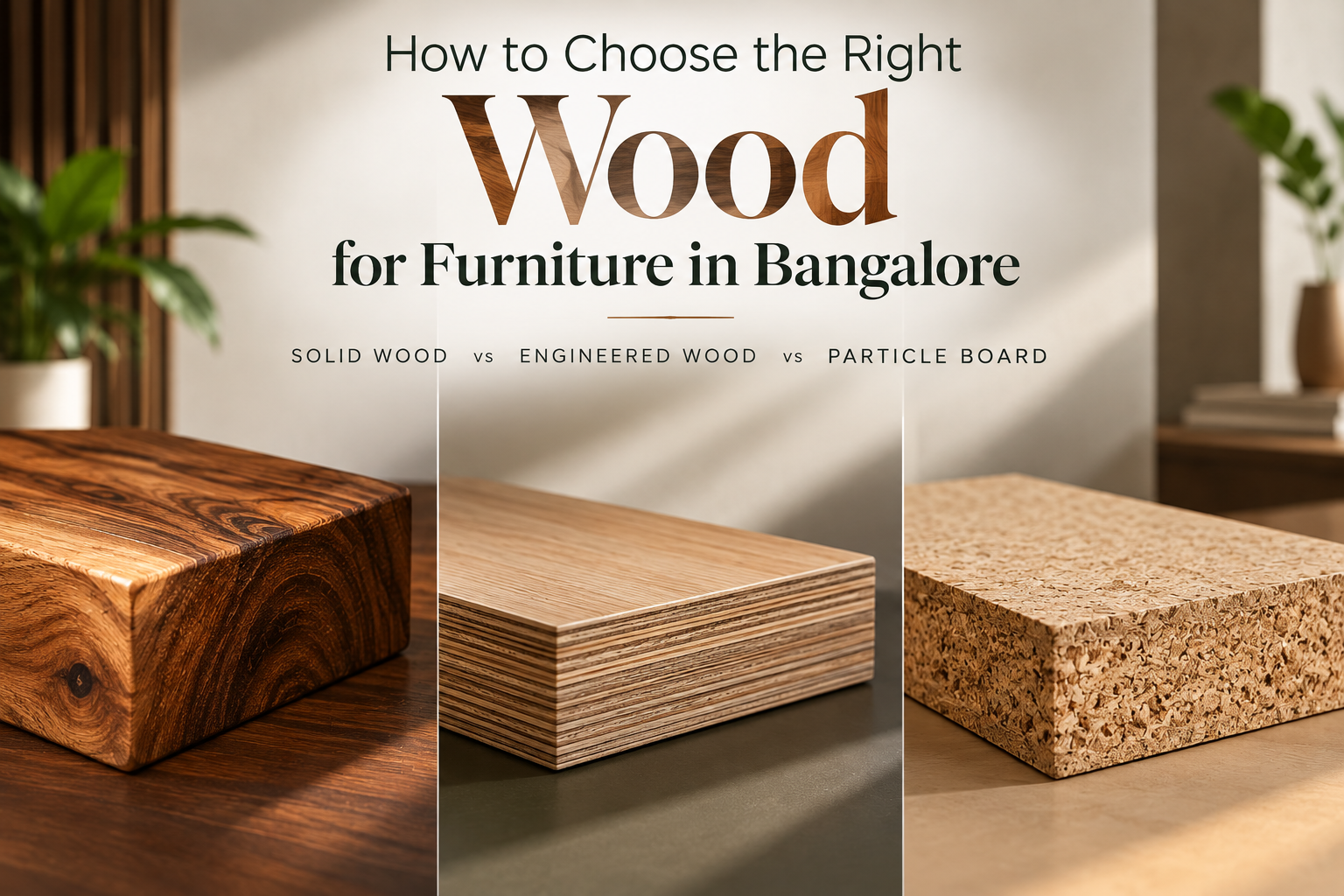
Walk into any furniture showroom in Bangalore and you will hear three words used constantly — wood, wooden, and solid wood. Walk into an online furniture platform and you will see product titles like "Solid Wood Study Table," "Engineered Wood Wardrobe," and "Premium Wooden Bed Frame" sitting side by side at wildly different price points.
Here is the truth: most buyers in Bangalore do not know the difference between these materials. And most sellers — both online and offline — are not particularly motivated to explain it clearly.
This blog is the explanation nobody gives you.
We will cover exactly what solid wood, engineered wood, and particle board are, how each performs in Bangalore's specific climate and home environments, which is right for which piece of furniture, and how to identify what you are actually buying before you spend your money.
By the end of this, you will never be misled by a furniture product description again.
The Three Materials — What They Actually Are
Solid Wood
Solid wood is exactly what it sounds like — furniture made from planks or boards cut directly from timber. There is no bonding agent, no compression process, no manufactured core. The grain you see on the surface runs all the way through the piece.
In India, the most commonly used solid woods for furniture are:
- Sheesham (Indian Rosewood) — the most popular solid wood for Indian furniture. Dense, durable, beautiful grain, naturally resistant to moisture and insects. Used extensively for beds, sofas, dining tables, and wardrobes.
- Teak — premium, highly durable, naturally oil-rich which makes it resistant to warping and moisture. Used for high-end furniture and outdoor applications.
- Mango wood — lighter and more affordable than sheesham, attractive grain, increasingly popular for contemporary furniture.
- Acacia — hard, dense, attractive grain. Used for dining tables and accent furniture.
- Pine — softer than the above, lighter in colour, used for Scandinavian-style furniture. Less resistant to dents and scratches.
What solid wood looks like in real life:
Every piece of solid wood furniture is slightly unique. The grain pattern varies. The colour has natural depth and variation. When you run your hand across solid wood, it has a warmth and weight that no manufactured material replicates. When you knock on it, it sounds solid and dense.
Engineered Wood
Engineered wood — also called manufactured wood or composite wood — is made by bonding together wood fibres, veneers, or layers using adhesive resins under heat and pressure. The result is a sheet material that is then cut and shaped into furniture components.
The two most common types of engineered wood used in furniture are:
MDF (Medium Density Fibreboard) MDF is made by breaking down wood fibres into a fine pulp, mixing with resin, and pressing under high heat. The result is an extremely smooth, uniform panel with no grain variation. MDF takes paint and veneer exceptionally well, which is why it is the standard material for painted furniture and high-gloss finishes.
MDF is dense and heavy. It does not have the structural grain of solid wood, which means it cannot be screwed and re-screwed in the same hole (the hole strips over time). But for fixed furniture — wardrobes, modular kitchen units, painted cabinets — MDF is a practical, cost-effective material.
Plywood Plywood is made by gluing together thin layers (plies) of wood veneer at alternating grain directions. This cross-grain construction gives plywood excellent strength in multiple directions and good resistance to warping. Plywood holds screws well, handles moisture better than MDF, and is the preferred engineered wood for structural furniture components — drawer bases, wardrobe backs, bed slats.
Good quality plywood (IS 710 grade, BWR or BWP certified) is a genuinely strong and durable material. Budget plywood is significantly less so.
What engineered wood looks like in real life: Engineered wood furniture typically has a smooth, uniform surface. The "wood grain" you see on most engineered wood furniture is a printed paper or PVC laminate applied on top of the core. Look at the edges — on a cut or exposed edge, engineered wood shows its composite core rather than a continuous grain pattern.
Particle Board
Particle board — also called chipboard — is made by compressing wood chips, sawdust, and wood shavings with resin binders into flat panels. It is the lowest tier of manufactured wood board.
Particle board is lighter than MDF, cheaper to produce, and significantly less dense and durable. It has poor screw-holding ability, especially at edges. It is highly susceptible to moisture — even moderate dampness causes particle board to swell, bubble, and delaminate. It does not age well under regular use.
In India, a significant proportion of the budget furniture sold online — in the Rs 5,000 to Rs 25,000 range — is made from particle board with a printed wood-grain foil on the surface. It looks identical to MDF or even to a wood-veneer finish in product photographs. In person, you can identify it by its lighter weight, hollow sound when knocked, and visible chipboard texture at cut edges.
What particle board looks like in real life: Noticeably lighter than MDF or solid wood of the same size. When you knock on particle board furniture, it sounds hollow and thin. At exposed edges — inside drawer rails, underneath shelves, at the back panel — you can see the compressed chip texture rather than a smooth core or continuous grain.
How Each Material Performs in Bangalore's Climate
This is where the material choice becomes genuinely important for Bangalore buyers specifically.
Bangalore has a moderate climate overall, but it is not a neutral environment for furniture:
- Monsoon months (June to September) bring sustained humidity — relative humidity regularly exceeds 80 percent during heavy rain periods.
- Temperature swings between cool winter mornings and warm summer afternoons cause wood to expand and contract.
- Homes without consistent AC — which includes most Bangalore apartments outside premium segments — experience these swings directly.
Here is how each material responds:
Solid wood in Bangalore's climate: Solid wood expands and contracts with humidity and temperature changes. This is normal and manageable with proper finishing (sealing, polishing, oiling). Well-finished solid sheesham or teak handles Bangalore's monsoon comfortably. Over years, solid wood develops a patina — the surface deepens and ages beautifully. Solid wood furniture, properly cared for, lasts 15 to 30 years and often longer.
Engineered wood (MDF/Plywood) in Bangalore's climate: Good quality MDF with proper laminate or veneer finish handles moderate humidity reasonably well. It does not expand and contract the way solid wood does, which means fewer squeaks and gaps over time. However, if the laminate or edge banding is compromised — a chip, a scratch, a poorly sealed edge — moisture enters and MDF begins to swell. Plywood performs better than MDF in moisture-prone areas (bathrooms, kitchens) because of its cross-grain structure.
Particle board in Bangalore's climate: This is where particle board's fundamental weakness is most exposed. In Bangalore's monsoon humidity, particle board furniture — especially in lower-floor apartments, older buildings with poor ventilation, or rooms near kitchens and bathrooms — is at real risk of moisture damage. Swelling at edges, bubbling of the laminate surface, and delamination of the printed foil are common within 2 to 4 years. Budget particle board furniture bought online often fails faster in Bangalore than it might in drier climates.
Room by Room: Which Material Works Best Where
Understanding the material is only half the question. The other half is where in your home it will be used — because the right material for a wardrobe is not necessarily the right material for a dining table.
Living Room — Sofa Frame, Center Table, TV Unit
Best material: Solid wood or plywood frame
The sofa frame is hidden under upholstery, but it is what determines whether your sofa holds its shape for 3 years or 12 years. A solid sheesham or kiln-dried hardwood frame is the benchmark. A high-quality plywood frame (12mm or thicker, good grade) is a reasonable alternative.
The TV unit and center table are visible and handled daily. Solid wood with a natural finish or a well-made MDF unit with a quality veneer both work well. Avoid particle board for TV units — the weight of electronics and the screws required for cable management and mounting degrade particle board quickly.
Bedroom — Bed Frame, Wardrobe, Dressing Table
Bed frame: Solid wood or premium plywood The bed frame bears weight every night. Solid wood — sheesham, teak, or mango — is the ideal material. A well-built plywood frame (marine grade, minimum 18mm thickness) is an acceptable alternative. Particle board bed frames, especially those with a storage mechanism, fail at joints and hinges within 2 to 3 years of regular use.
Wardrobe: MDF or plywood with quality laminate This surprises many buyers — but a well-made MDF or plywood wardrobe is often a better practical choice than solid wood. Here is why: engineered wood does not warp the way solid wood can when exposed to the humidity changes in a bedroom. A solid wood wardrobe door can warp and refuse to close properly if the humidity swings significantly. MDF doors with good quality hinges stay true. Ensure all edges are properly sealed and the internal surfaces are laminated.
Dressing table: MDF or solid wood Both work well. MDF gives a smoother painted finish. Solid wood gives a warmer, more premium look and lasts longer.
Dining Room — Dining Table, Chairs
Best material: Solid wood or stone top (marble/glass)
The dining table is the most heavily used horizontal surface in the home. It handles heat from hot vessels, spills, scratches from cutlery, and the daily weight of elbows and laptops. Solid wood — particularly sheesham or teak — is the ideal material for a dining table that will be used daily by a family.
Marble and glass tops on metal or solid wood frames are excellent alternatives. The top surface is impervious to spills and heat marks. The frame must be solid wood or metal — not particle board.
Dining chairs can be solid wood or metal-framed with upholstered seats. MDF chair seats with upholstery are common at mid-range prices and perform adequately. Avoid fully particle board dining chairs — the leg joints fail quickly under the stress of daily use.
Home Office — Desk, Study Table
Best material: MDF with quality laminate or solid wood
A home office desk takes a great deal of daily mechanical stress — keyboards, monitors, coffee cups, books, cables. A good quality MDF desk with thick laminate and properly sealed edges performs well and is the material of choice at mid-range prices.
If you want a desk that ages beautifully and lasts a decade or more, a solid wood desktop (sheesham or acacia) on metal legs is an excellent investment.
Particle board desks — very common at online price points of Rs 5,000 to Rs 12,000 — are a poor long-term choice for a workspace used 6 to 8 hours a day. The edges chip, the surface scratches, and the laminate peels within 2 years.
How to Identify the Material Before You Buy
This is the practical skill most furniture guides skip entirely.
In a showroom:
- Ask directly. A reputable showroom will tell you the exact material of every component — frame, panels, top surface. If a salesperson cannot answer or is vague, that is significant information.
- Lift the piece or a component. Solid wood is noticeably heavier than engineered wood of the same size. Particle board is lighter than both.
- Knock on a flat surface. Solid wood gives a dense, resonant knock. MDF gives a duller, heavier knock. Particle board gives a hollow, thin sound.
- Look at the edges. Exposed edges on a drawer interior or a shelf underside tell you the material immediately — continuous grain is solid wood, smooth uniform grey or beige is MDF, layered plies is plywood, chip texture is particle board.
- Open a drawer and look inside. Premium furniture uses quality materials even where they are not visible. Budget furniture uses its worst materials where they are least visible.
The Honest Price Guide
Understanding what material to expect at each price point in the Bangalore furniture market helps set realistic expectations:
Under Rs 10,000 per piece: Almost certainly particle board with printed laminate. Fine for very light-use, short-term, or low-stakes pieces. Not recommended for beds, dining tables, or sofas.
Rs 10,000 to Rs 25,000 per piece: Mix of particle board and MDF depending on the brand and piece. Better brands in this range use MDF for main panels and plywood for structural components. Ask specifically.
Rs 25,000 to Rs 60,000 per piece: Predominantly MDF and plywood with quality laminate or veneer. Some solid wood pieces — particularly beds and dining tables — appear in this range in sheesham or mango wood.
Rs 60,000 and above per piece: Solid wood — sheesham, teak, or imported hardwoods — is standard in this range. Premium engineered wood with real wood veneer also appears. Quality at this tier should be verifiable in person.
MaxFurn's Commitment to Material Transparency
At MaxFurn, we believe you deserve to know exactly what you are buying before you spend your money. In every one of our three showrooms across North Bangalore, our team will tell you:
- The exact material used for every component of every piece
- The difference between solid wood, engineered wood, and particle board in real products you can see and handle in person
- Which material is the right choice for your specific room, usage pattern, and budget
We stock furniture across material tiers — solid sheesham and teak collections, quality MDF and plywood modular furniture, and everything in between — because different rooms and different budgets call for different solutions. What we never do is describe a material as something it is not.
The Bottom Line
Solid wood is the premium, long-lasting choice. It ages beautifully, handles Bangalore's climate well with proper finishing, and is the right material for beds, dining tables, sofa frames, and statement pieces. It costs more — and it is worth it for pieces you will use every day for 10 years or more.
Engineered wood (MDF and plywood) is a practical, cost-effective material when it is good quality and properly finished. It is the right choice for wardrobes, modular furniture, painted pieces, and home office furniture. Do not dismiss it — a well-made MDF wardrobe will outlast a poorly made solid wood one.
Particle board is a budget material with significant limitations in Bangalore's climate. It is acceptable for very light-use, short-term, or low-stakes pieces. It is a poor choice for beds, dining tables, sofas, wardrobes, or anything expected to last more than 3 years under regular use.
The most important thing you can do as a furniture buyer in Bangalore is to ask what the piece is actually made of — and to choose a showroom where the answer is given honestly.


