



Blog
Ergonomic Office Chair vs Regular Chair: The Honest Answer for Anyone Working From Home

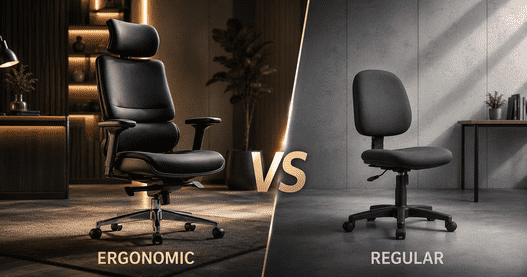
An honest, evidence-based comparison for Bangalore's work-from-home professionals
— backed by posture science, real costs, and practical advice.
Bangalore WFH
professional
back pain at some
point
with ergonomic seating
from poor posture issues
If you have been working from home in Bangalore for the past few years, you have probably
sat through more hours at your desk than you ever did in an office. And if you have been
doing that on a plastic dining chair, a repurposed bedroom chair, or a cheap task chair from
an online sale — your back already knows the answer to the question in this title.
But let us answer it properly. Because 'ergonomic chair' has become a marketing term applied to
almost anything with a lumbar bump and an adjustable armrest — and a genuinely ergonomic chair is
something quite specific, quite different, and for many people, genuinely life-changing.
This guide covers what ergonomics actually means in chair design, what features matter and which
are marketing noise, what the research says about posture and productivity, and how to decide what
is right for your budget and work situation in Bangalore.
What Does 'Ergonomic' Actually Mean?
Ergonomics is the science of designing equipment to fit the human body — not the other way around.
An ergonomic chair is one designed to support the natural curves and movements of your spine,
reduce muscle strain, and allow you to maintain a neutral posture for extended periods.
A truly ergonomic chair is not just one with more levers. It is one where those adjustments allow
different body types — different heights, different torso lengths, different sitting styles — to achieve
the same outcome: a spine in its natural S-curve, hips at or slightly above knee level, shoulders
relaxed, and neck in a neutral position.
Pro Tip
The goal of an ergonomic chair is not to make sitting comfortable — it is to make
sitting safe. Prolonged sitting is inherently stressful on the spine. Ergonomic design
minimises that stress rather than masking it.
What a Regular Chair Does Instead
A regular chair — whether a dining chair, a basic task chair, or a generic office chair — is designed
around average dimensions and a fixed posture. It assumes you will sit in one position, that your body
fits standard proportions, and that you will not be sitting for more than an hour or two at a stretch.
None of those assumptions hold for a modern work-from-home setup in Bangalore, where 6 to 10
hours of desk time per day is common for IT professionals, business owners, and remote workers.
| Feature | What It Does | Ergonomic Chair | Regular Chair |
|---|---|---|---|
| Lumbar support | Supports inward curve of the lower spine | Adjustable height + depth | Fixed bump or none |
| Seat height | Aligns hips correctly for your leg length | Pneumatic, wide range | Fixed or very limited |
| Seat depth | Prevents pressure behind the knees | Sliding seat pan | Fixed — one size only |
| Armrests | Keeps shoulders relaxed, reduces neck strain | 4D: height, width, depth, angle | Fixed height or none |
| Backrest recline | Allows movement, reduces disc pressure | Multi-angle lock + tension control | Fixed or basic tilt |
| Headrest | Supports cervical spine during recline | Adjustable height + angle | Rarely included |
| Seat cushion | Prevents pressure points and numbness | High-density memory foam or mesh | Basic foam, compresses quickly |
| Breathability | Reduces heat build-up during long sitting | Mesh back on premium models | Solid foam back, can feel warm |
What Prolonged Sitting on the Wrong Chair Actually Does
Slouching forward on a low fixed-height chair increases lumbar disc pressure by 40 to 90 percent compared to a neutral seated position. Over months, the deep stabilising muscles of the spine reduce activity, the hip flexors shorten, and the characteristic low back pain of desk workers sets in.
Neck strain accumulates just as quietly. For every inch the head moves forward of the shoulders, effective weight on the cervical spine increases by 4 to 5 kg — a problem that begins within minutes on a poorly positioned chair with no armrest or headrest support.
An ergonomic chair addresses these directly: adjustable lumbar support maintains the natural spinal curve, correct seat height keeps the pelvis neutral, and adjustable armrests eliminate the shoulder tension that builds from unsupported arms across a long workday.
Pro tip :
IT professionals, startup founders, and remote workers in Bangalore routinely log 8 to 12 hour desk days. At that duration, the difference between a correctly adjusted ergonomic chair and a dining chair is not comfort — it is cumulative musculoskeletal damage over months and years.
Does It Actually Improve Productivity?
The short answer is yes — but not in the way productivity marketing usually frames it. An ergonomic
chair does not make you work faster. What it does is reduce the physical discomfort that pulls
attention away from your work.
Chronic low back pain, neck stiffness, and shoulder tension are not just uncomfortable — they are
cognitively distracting. When your body is in pain, a portion of your mental bandwidth is always
occupied by that pain, even when you are not consciously aware of it.
The productivity gains reported in occupational health studies — typically 17 to 35 percent — come
from three effects: reduced physical discomfort, reduced fatigue over long workdays, and reduced
absenteeism from posture-related health issues. For Bangalore's WFH workforce, the argument is
even stronger because daily desk time without a commute is significantly greater.
The Real Cost of a Cheap Chair
The price gap feels significant — a regular task chair costs Rs 2,000 to Rs 6,000 while a good ergonomic chair costs Rs 8,000 to Rs 30,000. But a Rs 3,500 chair replaced every 2 years costs more per year than a Rs 15,000 ergonomic chair spread over 7 years — before accounting for a single physio visit. A Rs 15,000 ergonomic chair used 8 hours a day over 7 years works out to roughly Rs 0.73 per hour of use. That is the actual cost of protecting your spine at your desk.
What to Look for When Buying in Bangalore
Non-Negotiable Features
• Adjustable lumbar support — must adjust in height. Fixed lumbar bumps fit almost nobody
correctly.
• Seat height range of 42 to 52 cm — covers most adult heights in India. Confirm the range if you
are above 5'10" or below 5'3".
• Adjustable armrests — height adjustment at minimum. 4D armrests (height, width, depth, angle)
are ideal.
• Reclinable backrest with lock — should recline to at least 120 degrees and lock at multiple
positions.
• Solid five-star base — with smooth-rolling castors matched to your floor type.
Worth Having
• Mesh backrest — significantly better ventilation than foam, especially important in Bangalore's warm weather. • Adjustable headrest — essential for those who recline during calls or thinking sessions. • Seat depth adjustment — major benefit for taller buyers; rarely found under Rs 12,000.
Mostly Marketing
• Massage function — vibration does not reduce posture-related strain. A comfort feature, not an ergonomic one.
• Leather upholstery — traps heat during long sessions. Mesh or quality fabric is functionally superior.
• 'Orthopedic' labelling without specification — ask what it means. If the seller cannot explain the lumbar design, it is a marketing label.
What to Expect at Each Budget in Bangalore
• Rs 2,000 – 5,000 (Basic task chair): Fixed height, basic foam, minimal adjustment. Fine for occasional use or a child's study table.
• Rs 5,000 – 10,000 (Entry ergonomic): Height adjustment, basic lumbar, fixed armrests. Adequate for 3–4 hour daily use.
• Rs 10,000 – 20,000 (Mid-range ergonomic): Adjustable lumbar, 4D armrests, mesh back option, recline lock. Recommended for full-time WFH.
• Rs 20,000 – 40,000 (Premium ergonomic): Full adjustability, sync tilt, seat depth adjustment, headrest, quality mesh. Best for 8–10 hour desk days.
• Rs 40,000+ (Executive ergonomic): High-end materials, advanced posture tech, 10+ year warranty. A serious long-term health investment.
Pro Tip
At MaxFurn, a Rs 15,000 ergonomic chair on a 12-month EMI plan costs under Rs
1,300 per month — less than most Bangaloreans spend on a single weekend
dining-out bill.
8 Things to Check Before You Buy
Do not buy any office chair without sitting in it for at least 10 minutes and running through these
checks:
• Sit for 10 minutes — discomfort only shows after 8–10 minutes on any chair.
• Adjust seat height — feet should rest flat on the floor, hips at or above knee level.
• Set lumbar support — the pad should press gently into your lower back curve, not mid-back.
• Test armrest position — shoulders should stay relaxed. If they lift to reach the armrests, they are
too high.
• Recline and lock — recline should be smooth. Lock at 100–110 degrees and confirm it holds your
weight.
• Sit with eyes closed for 2 minutes — even pressure across the seat is correct. Pressure under
the thighs signals a fit issue.
• Ask about weight capacity — most chairs are rated to 100–110 kg. Confirm if you are above
this.
• Confirm warranty in writing — mechanism and upholstery warranties are separate. Good chairs
carry 2–5 year mechanism warranties.
The Verdict: Does It Actually Make a Difference?
Yes — but only if you buy the right one and set it up correctly. For anyone sitting more than 5 hours a day at a desk, a properly adjusted ergonomic chair is not a luxury. It is occupational health infrastructure. The adjustability — the ability to fit the chair precisely to your body — is what delivers the benefit. A cheap chair with a fixed lumbar bump and non-adjustable armrests labelled 'ergonomic' delivers almost none of it.
A regular chair used occasionally — 2 hours a day, a few times a week — is perfectly adequate. The risk is not from sitting on a regular chair. It is from sitting on one all day, every day, for years.
Choose Ergonomic if...
- Sit 6+ hours a day at a desk
- Have existing back, neck or shoulder pain
- Work from home full-time or hybrid
- Want long-term health protection
- Budget: Rs 8,000 to Rs 30,000+
Choose Regular if...
- Sit fewer than 3 hours at your desk
- Need it for occasional or guest use only
- Budget is tightly constrained (under Rs 4,000)
- Setting up a child's study table
- It is a temporary setup (6 months or less)


